Comprehensive Design Studio - Final Project
In a city shaped by uncertainty, the project asserts that true luxury lies in having a choice.
This proposal envisions a vertical community where resilience is expressed through porosity, adaptability, and plurality. The tower acts as a structural and spatial framework rather than a fixed monument. It accommodates shifting needs — from private dwelling to communal gathering, from open terraces to sheltered niches — ensuring that residents are never bound to one way of living.
Resilience is not mere survival. It is the capacity to adapt, absorb, and transform without breaking. In this project, resilience is framed as the continual provision of the luxury of choice. Choice of movement, choice of community, choice of exposure, choice of time.
t-SNE & K-means
t-SNE (t-distributed Stochastic Neighbor Embedding) is a dimensionality reduction algorithm that takes high-dimensional data—such as 7 different metrics describing building footprints—and maps them into a lower-dimensional space, typically 3 dimensions for visualization. It does this by preserving local similarities: buildings with similar metric profiles remain close in the 3D output space, while dissimilar ones are placed farther apart. The result is a 3D cluster visualization where each point represents a building footprint, and spatial proximity within the cluster reflects similarity in their original 7-metric profiles.
K-means clustering is an unsupervised machine learning algorithm that categorizes data points into a predefined number of groups—in this case, 11. After t-SNE reduces the building footprint metrics into a 3-dimensional space, K-means analyzes the spatial distribution of these points and partitions them into 11 clusters based on their proximity to each other. It does this by iteratively assigning each point to the nearest of 11 centroids (representing cluster centers) and updating those centroids until the assignments stabilize. The result is a categorization of the data into 11 distinct groups, each representing a pattern or type of building footprint based on the original 7 metrics.
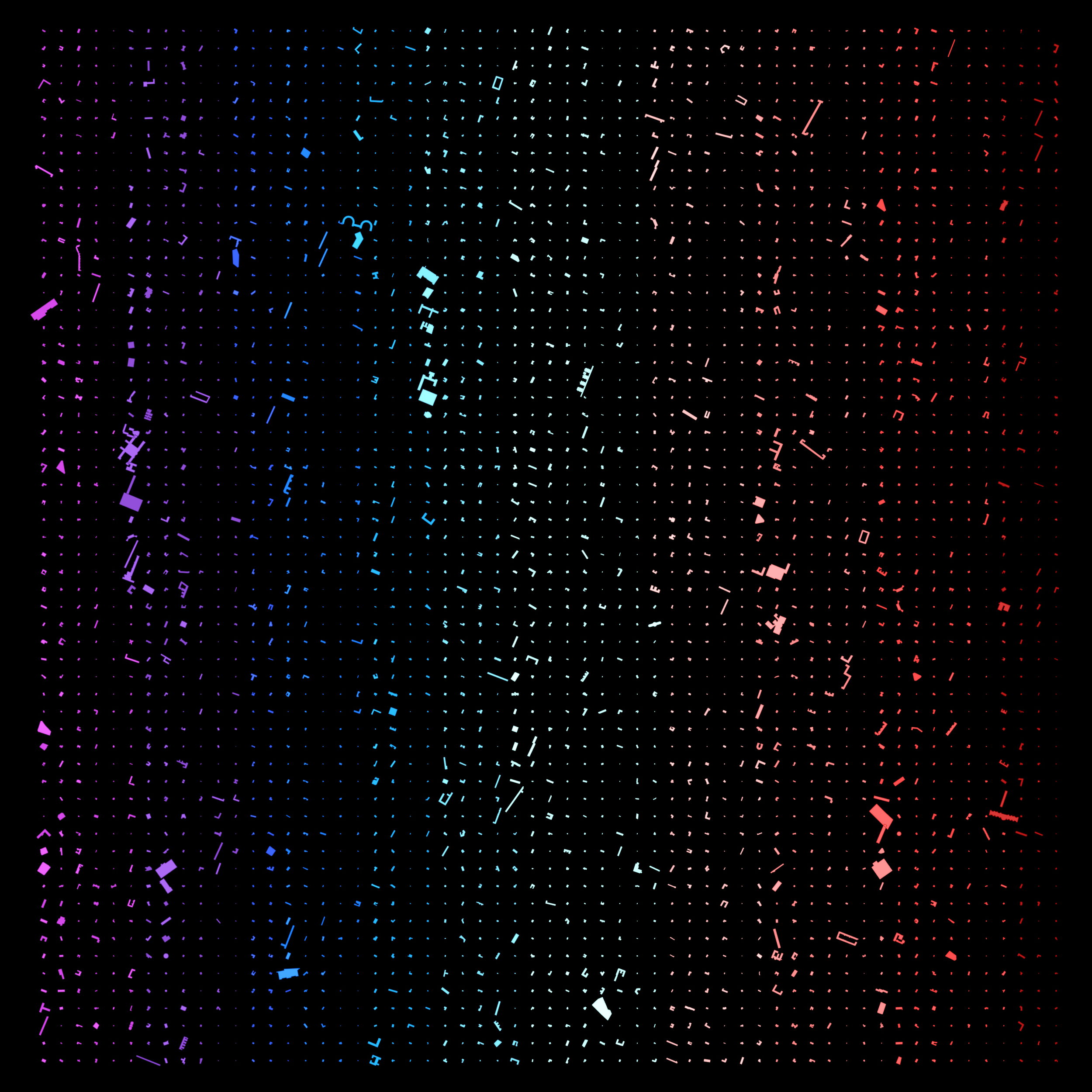
The cluster is then laid out in 2D space to observe patters in footprint morphology.
Finally, the group annotations were plotted onto the Copenhagen map to observe relation to location and actual proximity and trends.

Color-coded street map of an urban area on a black background, with buildings and streets highlighted in pink, blue, purple, and white. t-SNE and K-means urban footprint morphology analysis on Copenhagen.